


The question this page answers
The question this page answers
How does serious gang violence affect Swedish businesses, investment and local commerce — and what can actually be documented in the data?
At a glance
At a glance
Key figures — the most important numbers on this page
2023
≈ 1 in 4
Greater-Stockholm business owners considering relocation for safety reasons (Chamber survey)
2024
≈ 30 %
Firms in exposed sectors citing crime as a top-three obstacle (Confederation of Swedish Enterprise)
2024
44
Fatal shootings in Sweden (Brå)
2025
189
Completed bombings (Police)
2023
≈ SEK 2 bn
Police special operation against serious organised crime (annual report)
2025
65
Areas on the Police 'Lägesbild' list
Ten years, two records
Fatal shootings per year(Brå)
- 2011
- 17 (2011)
- 2022–2025
- 63 (2022) → 53 (2023) → 44 (2024)
Completed bombings(Police)
- 2011
- < 30 (1990s)
- 2022–2025
- 149 (2023) → 195 (2024) → 189 (2025)
Children (<18) killed in gang shootings(Brå/SVT)
- 2011
- 1
- 2022–2025
- 12
Police vulnerable areas(Police)
- 2011
- 53 (2015)
- 2022–2025
- 65 (2025)
| Mått | 2011 | 2022–2025 |
|---|---|---|
| Fatal shootings per year(Brå) | 17 (2011) | 63 (2022) → 53 (2023) → 44 (2024) |
| Completed bombings(Police) | < 30 (1990s) | 149 (2023) → 195 (2024) → 189 (2025) |
| Children (<18) killed in gang shootings(Brå/SVT) | 1 | 12 |
| Police vulnerable areas(Police) | 53 (2015) | 65 (2025) |
Sweden in 2024 has more bombings per capita than any other country in the EU and more fatal firearm victims among young men than any country in Western Europe (EUDA, Europol EU SOCTA 2025).
How to read this: The table shows register data from Brå and the Police — not surveys. It does not show how firm turnover or the number of establishments has changed; that requires separate survey data and register-based establishment decisions.
What the data shows
What does the data show?
Objective observations — not interpretations
- Business surveys (Confederation of Swedish Enterprise, Chambers of Commerce) rank insecurity from 2023 as one of the most common obstacles to enterprise in affected municipalities — especially in retail, hospitality and personal services.
- Register data (Brå, Police) show a rising trend for bombings and a continued high level of fatal shootings in or near commercial environments.
- Individual cases — burned-down restaurants, closed shops, cancelled bus lines — are documented in local media but there is no national aggregate statistic.
- Insurers' claims data (Svensk Försäkring) show rising premiums and coverage exclusions for certain postal areas, but are not published as an open time series.
- Research on the economic consequences of gang violence in Sweden is still thin — a handful of studies from IFN and Ratio, but no established consensus model.
Definitions
Definitions
How the numbers are counted — and what they do not cover
- Crime-exposed business
- A business that during a given period has been subjected to at least one crime — theft, vandalism, threats, robbery, extortion or fraud. Measured in the Confederation of Swedish Enterprise's business panel and Brå's Business Survey.Source: Brå — Business Survey; Confederation of Swedish Enterprise — business panel.
- Extortion / protection racket
- Demand for payment from a criminal actor as a condition for a business to operate unmolested. Regulated as extortion (Penal Code ch. 9 §4). Brå judges the dark figure to be very large — few incidents are reported for fear of reprisal.Source: Brå — Unlawful influence on business owners (2022).
- Business climate survey
- The Confederation of Swedish Enterprise's annual survey of about 30 000 owners in every municipality. Since 2016 it includes questions on insecurity and crime as barriers to enterprise. It is a subjective perception measure, not a register source.Source: Confederation of Swedish Enterprise — Business Climate.
- Establishment decision
- A firm's choice to start, expand, relocate or shut down operations at a given site. Driven by rents, skills supply, customer base, infrastructure — and in recent years increasingly also by the security situation. No Swedish agency publishes aggregate data directly linking establishments to crime.Source: Tillväxtverket — Firms' conditions and reality.
- Claims frequency (insurance)
- Compensated claims per insured unit per year. Used in property insurance to set premiums. Higher fire and vandalism frequencies in certain postal areas lead to higher premiums or exclusions in the terms.Source: Svensk Försäkring — statistics and key figures.
- Completed bombing
- Detonation of an explosive that was actually carried out (as opposed to preparation or a discovered unexploded device). The Police time series counts completed bombings; Brå's statistic for 'public endangerment' is broader and includes attempts.Source: Police — annual bombing statistics.
- Organised crime
- Structured criminal activity in a group with an economic purpose that continues over time. The Police and the EU (Europol) use overlapping definitions. During the 2020s Sweden has been classified as one of the EU's most gang-violence-affected countries per capita (Europol EU SOCTA 2025).Source: Europol EU SOCTA 2025; Police — organised-crime situational picture.
- Criminal economy
- Umbrella term for financial flows in organised crime — narcotics, welfare fraud, scams, extortion, labour exploitation, money laundering. Brå (2023) estimated the size at SEK 100–150 bn per year, with a wide uncertainty range.Source: Brå 2022:1 — Criminal networks and their economy.
A criminologist on the scale of the problem
What we are seeing now is not ordinary crime statistics. It is a structural problem driven by a relatively small number of family-based networks with deep roots in specific neighbourhoods.
Brå's own research confirms the network character: a handful of large criminal families and clans account for a disproportionate share of the lethal violence and recruit children as young as 11–13 as contract killers.
What happens to businesses
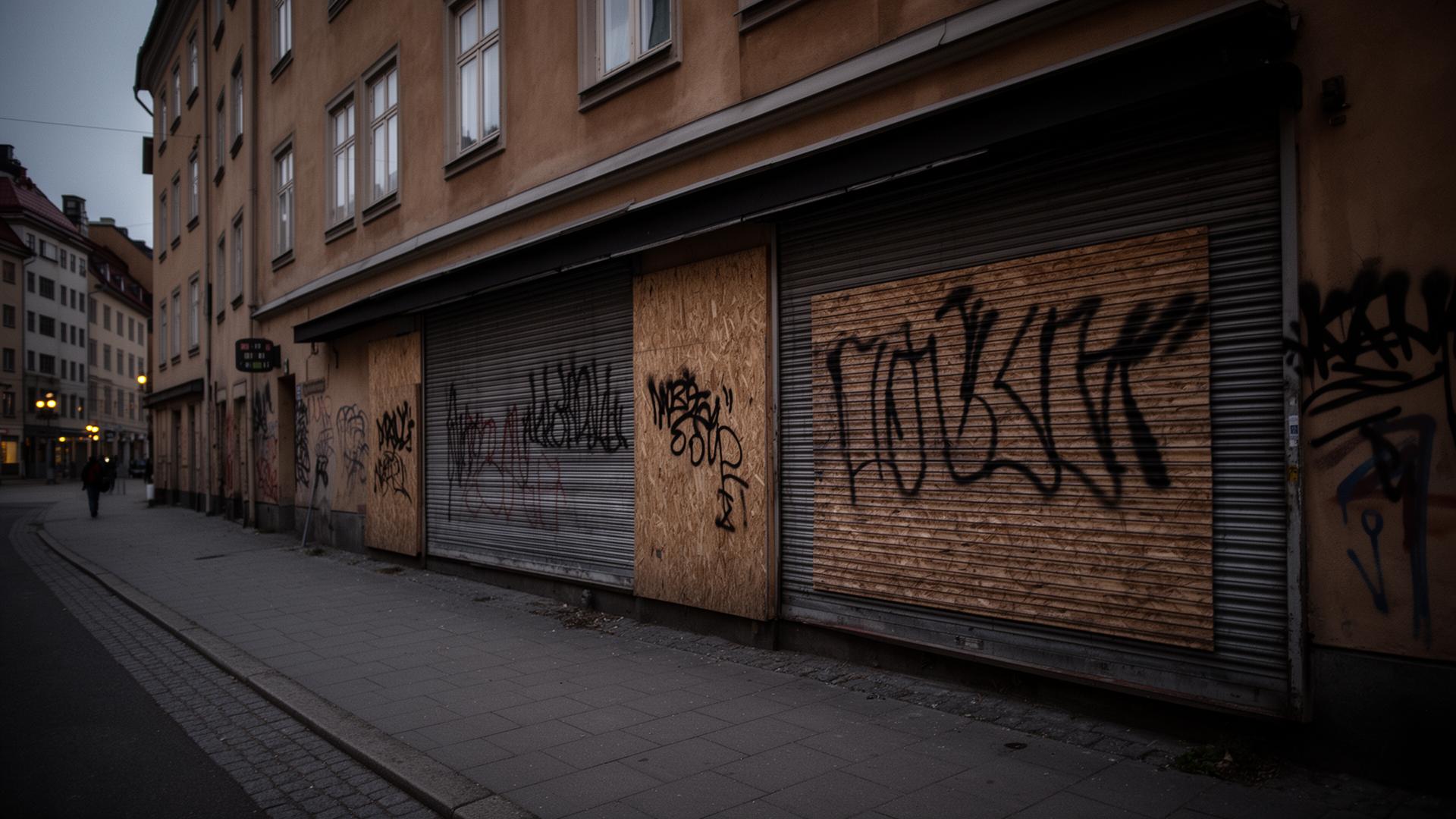
The Confederation of Swedish Enterprise reports that more than one in three SMEs in the most affected sectors say crime is now a top-three challenge. Shops in vulnerable areas report systematic theft, threats and protection rackets; several large chains have left individual districts entirely. The business climate has become a security question. Surveys from business organisations are member voices, not independent statistics — we report register data from Brå and the Police alongside them wherever it exists.
Method and uncertainty
- Shooting and bombing series come from ongoing Police statistics. "Completed bombings" is narrower than Brå's "public endangerment incl. attempts".
- Surveys from business organisations reflect members' perceptions, not independent crime statistics.
- Insurers' claims frequencies and premiums are not published openly per postal area; the picture builds on Svensk Försäkring aggregates and interviews.
- The Nordic multiplier (≈ 10×) refers to fatal shootings per capita among young men in the peak years 2022–2023.
Primary sources
Primary sources
Agencies and research institutions behind this page
6
agencies/institutions
8
reports & studies
3
primary datasets
Frequently asked questions
Frequently asked questions
Short answers to what is most often discussed
Related topics
Related topics
Logical next steps if you want to understand the background
The question this page answers
How does serious gang violence affect Swedish businesses, investment and local commerce — and what can actually be documented in the data?
At a glance
Key figures — the most important numbers on this page
2023
≈ 1 in 4
Greater-Stockholm business owners considering relocation for safety reasons (Chamber survey)
2024
≈ 30 %
Firms in exposed sectors citing crime as a top-three obstacle (Confederation of Swedish Enterprise)
2024
44
Fatal shootings in Sweden (Brå)
2025
189
Completed bombings (Police)
2023
≈ SEK 2 bn
Police special operation against serious organised crime (annual report)
2025
65
Areas on the Police 'Lägesbild' list
What does the data show?
Objective observations — not interpretations
- Business surveys (Confederation of Swedish Enterprise, Chambers of Commerce) rank insecurity from 2023 as one of the most common obstacles to enterprise in affected municipalities — especially in retail, hospitality and personal services.
- Register data (Brå, Police) show a rising trend for bombings and a continued high level of fatal shootings in or near commercial environments.
- Individual cases — burned-down restaurants, closed shops, cancelled bus lines — are documented in local media but there is no national aggregate statistic.
- Insurers' claims data (Svensk Försäkring) show rising premiums and coverage exclusions for certain postal areas, but are not published as an open time series.
- Research on the economic consequences of gang violence in Sweden is still thin — a handful of studies from IFN and Ratio, but no established consensus model.
Method note
The page combines three data sources: (1) register data from Brå and the Police (shootings, bombings), (2) survey data from the Confederation of Swedish Enterprise and the chambers of commerce (member firms), (3) industry statistics from Insurance Sweden (aggregates). Survey data are not independent crime statistics — they reflect employers' perceptions. The Nordic multiple refers to per-capita fatal shootings in peak years 2022–2023.
Definitions
How the numbers are counted — and what they do not cover
- Crime-exposed business
- A business that during a given period has been subjected to at least one crime — theft, vandalism, threats, robbery, extortion or fraud. Measured in the Confederation of Swedish Enterprise's business panel and Brå's Business Survey.Source: Brå — Business Survey; Confederation of Swedish Enterprise — business panel.
- Extortion / protection racket
- Demand for payment from a criminal actor as a condition for a business to operate unmolested. Regulated as extortion (Penal Code ch. 9 §4). Brå judges the dark figure to be very large — few incidents are reported for fear of reprisal.Source: Brå — Unlawful influence on business owners (2022).
- Business climate survey
- The Confederation of Swedish Enterprise's annual survey of about 30 000 owners in every municipality. Since 2016 it includes questions on insecurity and crime as barriers to enterprise. It is a subjective perception measure, not a register source.Source: Confederation of Swedish Enterprise — Business Climate.
- Establishment decision
- A firm's choice to start, expand, relocate or shut down operations at a given site. Driven by rents, skills supply, customer base, infrastructure — and in recent years increasingly also by the security situation. No Swedish agency publishes aggregate data directly linking establishments to crime.Source: Tillväxtverket — Firms' conditions and reality.
- Claims frequency (insurance)
- Compensated claims per insured unit per year. Used in property insurance to set premiums. Higher fire and vandalism frequencies in certain postal areas lead to higher premiums or exclusions in the terms.Source: Svensk Försäkring — statistics and key figures.
- Completed bombing
- Detonation of an explosive that was actually carried out (as opposed to preparation or a discovered unexploded device). The Police time series counts completed bombings; Brå's statistic for 'public endangerment' is broader and includes attempts.Source: Police — annual bombing statistics.
- Organised crime
- Structured criminal activity in a group with an economic purpose that continues over time. The Police and the EU (Europol) use overlapping definitions. During the 2020s Sweden has been classified as one of the EU's most gang-violence-affected countries per capita (Europol EU SOCTA 2025).Source: Europol EU SOCTA 2025; Police — organised-crime situational picture.
- Criminal economy
- Umbrella term for financial flows in organised crime — narcotics, welfare fraud, scams, extortion, labour exploitation, money laundering. Brå (2023) estimated the size at SEK 100–150 bn per year, with a wide uncertainty range.Source: Brå 2022:1 — Criminal networks and their economy.
Primary sources
Agencies and research institutions behind this page
6
agencies/institutions
8
reports & studies
3
primary datasets
Frequently asked questions
Short answers to what is most often discussed
Related topics
Logical next steps if you want to understand the background
Sources for this page
The data comes from official primary sources.
Brå · Annually
Anmälda brottAnmälda brott
Latest data point · Source published
Brå · Annually
Konstaterade fall av dödligt våld (inkl. skjutvapenvåld)Konstaterade fall av dödligt våld med skjutvapen
Latest data point · Source published
Cite this page
Citations are welcome — credit Sverigefakta and link to the page, and also cite the primary source. Commercial reuse of our own material requires permission.
Sverigefakta.com. (2026). Sverigefakta. Retrieved 2026-09-20, from https://sverigefakta.com/en/what-happened-to-sweden/gang-violence
Sverigefakta.com (2026) Sverigefakta. Available at: https://sverigefakta.com/en/what-happened-to-sweden/gang-violence (Accessed: 2026-09-20).
Sverigefakta.com, "Sverigefakta", https://sverigefakta.com/en/what-happened-to-sweden/gang-violence (accessed 2026-09-20).
@misc{sverigefakta_2026_en_whathappenedtosweden_gangviolence,
  author       = {Sverigefakta.com},
  title        = {Sverigefakta},
  year         = {2026},
  howpublished = {\url{https://sverigefakta.com/en/what-happened-to-sweden/gang-violence}},
  note         = {Dataset v2026.2, accessed 2026-09-20}
}https://sverigefakta.com/en/what-happened-to-sweden/gang-violence
Sources
Read the full investigation of how Sweden has changed.
Back to the overview →